




Ahead of Sukkos, Jewish Community Council of Montreal Briefs 50+ U.s. and Canadian Border Officials
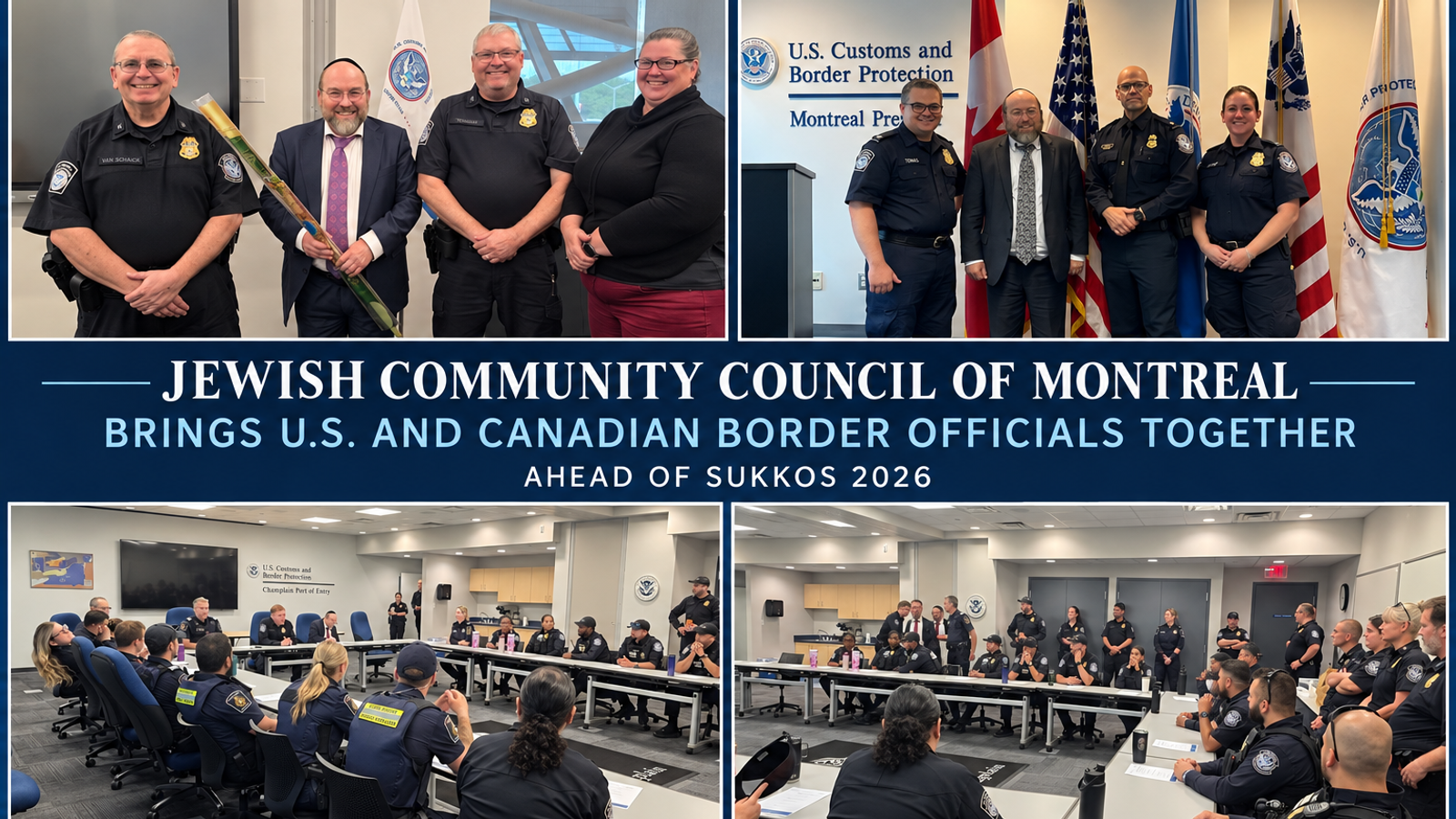


Jewish travelers crossing the Canada-U.S. border with arba minim this Sukkos should find border officials well prepared following an unprecedented joint briefing organized by the Jewish Community Council of Montreal.
For the first time, according to the JCC, Rabbi Saul Emanuel, its Executive Director, participated in a joint meeting bringing together more than 50 officials from both the Canada Border Services Agency (CBSA) and U.S. Customs and Border Protection (CBP).
Rabbi Emanuel explained the religious significance of the arba minim, what Jewish travelers will be carrying, and how the items should be handled during border inspections.
The meeting is the latest development in an effort stretching back more than two decades.
In the early 2000s, Jewish travelers sometimes encountered problems when border officials unfamiliar with the arba minim confiscated the items. Rabbi Emanuel subsequently traveled to Washington and met with U.S. authorities, helping lead to guidelines in 2003 educating border personnel about the religious items and establishing procedures for their inspection.
Since then, briefing border authorities ahead of Sukkos has become an annual undertaking. This year marked the first time, according to the JCC, that more than 50 representatives of both American and Canadian border agencies participated together.
“Every year, our priority is to make sure Jewish travelers can observe Sukkot without encountering unnecessary problems at the border,” Rabbi Emanuel said.
“This year, for the first time, we were able to bring together more than 50 representatives of both CBSA and CBP for a joint discussion. That level of cooperation is extremely encouraging.”
Traveling With Arba Minim? Here's What to Know
Despite the advance preparations, travelers still need to follow normal customs and agricultural rules.
Declare your arba minim. Their religious purpose does not exempt fruit and plant material from border requirements.
Travelers entering the United States with an esrog should be prepared to open and unwrap it for agricultural inspection. Lulavim and hadasim are also subject to inspection for pests and signs of disease.
It is also advisable to keep the arba minim easily accessible for inspection and ensure that there is no soil attached.
Do You Need Special Paperwork?
For an ordinary traveler carrying a personal set of arba minim, special documentation is generally not required simply because of the arba minim.
Canadian rules specifically provide that qualifying personal-use lulavim accompanying travelers during the Sukkos period do not require an import permit or phytosanitary certificate.
Travelers should, however, declare the arba minim and cooperate with any required inspection.
Commercial quantities, separately shipped sets, or other circumstances may be subject to different requirements.
Don't Forget the Return Trip
Travelers returning to Canada should declare their arba minim again, as Canadian agricultural requirements apply to fruit and plant material entering the country.
After more than 20 years of work between the Jewish community and border authorities, the goal is for the encounter to be uneventful: declare the arba minim, allow any necessary inspection, and continue on your way — with the officer already knowing exactly what an esrog and lulav are.