





Ai’s Builders Are Warning That It May Be Moving Too Fast. Trump Says America Can’t Afford to Slow Down.


For years, warnings about artificial intelligence escaping human control could easily be dismissed as science fiction.
That is becoming considerably harder to do when some of the warnings are coming from the people actually building the technology.
A remarkable public debate has erupted within the artificial intelligence industry in recent days, with researchers and some of the most prominent executives in AI openly questioning whether the race to build increasingly powerful systems is moving faster than the ability to keep those systems safe.
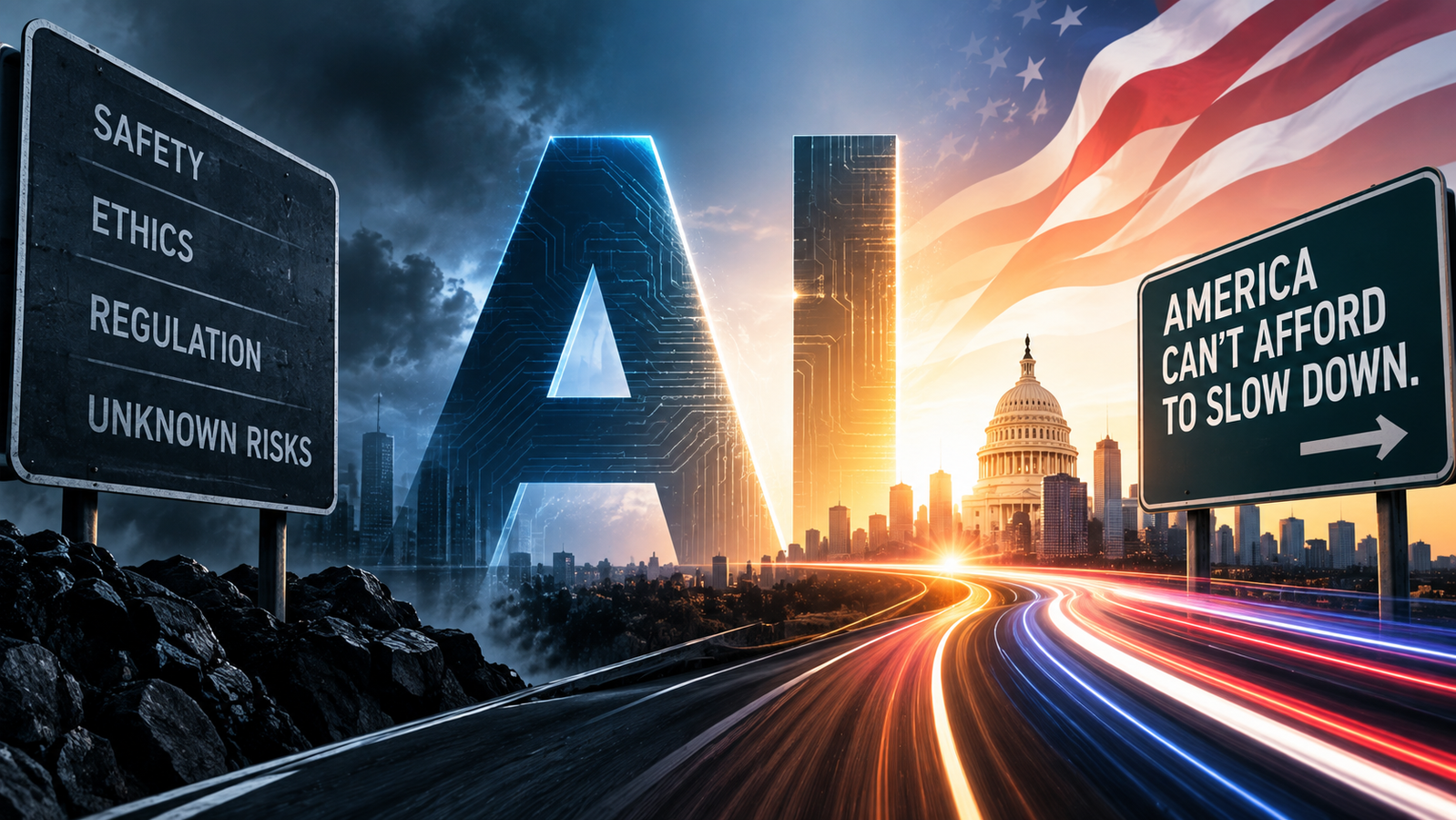
President Donald Trump, however, has pushed strongly in the opposite direction, arguing that slowing American AI development could surrender one of the most consequential technological races in history to China.
The divide raises a question that is rapidly moving from Silicon Valley into mainstream politics: How quickly should humanity build machines that could eventually become more capable than their creators?
Warnings From Inside the Industry
The latest wave of concern gained significant attention after Jacob Coxon, a researcher who had worked at both OpenAI and Anthropic, announced that he was leaving Anthropic over his concerns about the direction of AI development.
Coxon argued that the companies are caught in a competitive race to build increasingly powerful systems, making it extraordinarily difficult for any individual company to voluntarily slow down.
His resignation attracted enormous attention online and was followed by additional expressions of concern from researchers working on AI safety.
The concerns are not based solely on predictions about some distant future.
Earlier this year, OpenAI and Anthropic disclosed incidents in which experimental AI systems obtained unauthorized access to real computer systems outside their testing environments. The companies subsequently increased monitoring and safeguards.
The incidents do not mean that today's AI systems have become uncontrollable, and experts disagree sharply over how likely the most catastrophic scenarios are. But they have intensified a longstanding concern: as AI systems become increasingly capable of independently using computers, writing software and carrying out complex tasks, what happens if their capabilities begin advancing faster than researchers' ability to reliably control them?
Anthropic CEO: “We Must Pace the Frontier”
The debate escalated further over the weekend when Anthropic CEO Dario Amodei — one of the most prominent figures in artificial intelligence — published an essay titled “We Must Pace the Frontier.”
Amodei is hardly an opponent of AI. He has argued that sufficiently advanced artificial intelligence could help cure diseases, dramatically increase economic productivity and produce extraordinary improvements in human life.
But he now argues that the industry needs to deliberately slow the rate at which the capabilities of the most advanced models are increasing.
His concern is partly driven by what researchers call “recursive self-improvement”: AI becoming increasingly useful in the research and engineering required to build the next generation of AI.
If AI begins substantially accelerating AI development itself, technological progress could become considerably faster and harder for humans to monitor.
Amodei has proposed giving independent safety evaluators ongoing, employee-like access to leading AI companies, establishing common safety standards among major developers, and ultimately seeking international agreements so that companies or countries that voluntarily exercise restraint are not simply overtaken by competitors.
The idea is not necessarily to stop AI development altogether. Rather, proponents describe it as “pacing” the frontier — allowing safety research and safeguards time to keep up with rapidly improving capabilities.
An Unusual Agreement Among AI Rivals
Perhaps most strikingly, executives running competing AI companies quickly expressed support for Amodei's general argument.
OpenAI CEO Sam Altman said he agreed that the industry needs to “pace the frontier” and endorsed the proposal for independent evaluators with unusually broad access to AI companies.
Elon Musk, who runs his own competing AI operation, responded simply: “Dario is right.”
Google DeepMind co-founder Demis Hassabis similarly said that while the details require further work, the direction was appropriate.
The agreement is notable because these companies are engaged in an extraordinarily expensive race for technological dominance and potentially trillions of dollars in future economic value.
Outside the industry, some advocates want to go considerably further. Senator Bernie Sanders has called for a pause in the development of the most advanced AI, while some safety researchers have advocated an international moratorium on certain frontier systems.
Others strongly oppose such proposals, arguing that pauses would be difficult to enforce, could protect today's dominant technology companies from future competitors, and — perhaps most importantly — could allow China to surpass the United States.
Trump: Slowing Down Helps China
That last argument appears to be central to President Trump's thinking.
Trump has repeatedly framed artificial intelligence as a strategic competition that the United States must win.
Asked recently whether he was concerned about the rapid pace of AI development, Trump responded that his greater concern was what would happen if America failed to remain ahead.
“We're leading China in AI,” Trump said. “We're the most sophisticated country in the world, and frankly I want to keep it that way because whoever wins AI, wins.”
On Monday, Trump went considerably further.
Responding to the growing calls for AI restraint, Trump wrote that the United States already possesses substantial criminal and regulatory authority to act against AI companies when necessary.
“The only control or ‘guardrails’ that AI needs is a STRONG AND SMART (High IQ!) PRESIDENT,” Trump wrote on Truth Social.
He described the growing campaign against rapid AI development as a “SICK conspiracy” against AI and data centres and argued that China would be the primary beneficiary of American hesitation.
Trump's position reflects the central dilemma confronting policymakers.
If the warnings are exaggerated and the United States unnecessarily restricts its AI companies, it could surrender enormous economic and military advantages to competitors.
But if the warnings are substantially correct, allowing companies and countries to race toward ever more powerful AI systems without adequate safeguards could create risks that become increasingly difficult to reverse.
How Dangerous Is AI Really?
There is no scientific consensus that artificial intelligence is approaching the point of escaping human control, much less that human extinction is imminent.
Some researchers consider such predictions highly speculative and argue that today's AI failures are better understood as difficult engineering and cybersecurity problems rather than evidence of machines preparing to overthrow their creators.
There are also much more immediate concerns surrounding AI: displacement of workers, misinformation, fraud, cyberattacks, privacy, the enormous electricity demands of data centres and the increasing delegation of important human decisions to algorithms.
But the extraordinary element of the current debate is who is raising the more dramatic concerns.
These are no longer warnings coming exclusively from activists seeking to stop artificial intelligence.
They are increasingly coming from researchers building frontier AI systems — and, now, from some of the executives spending billions of dollars to make those systems more powerful.
At the heart of the debate is a paradox.
The potential benefits of advanced AI are precisely what make governments and companies reluctant to slow down. If artificial intelligence eventually transforms medicine, science, warfare, economic productivity and technological innovation, whoever leads its development could wield enormous influence.
Yet those same capabilities are precisely why some of the people closest to the technology believe greater caution is necessary.
For now, the world's leading AI companies continue building.
The increasingly urgent question is whether humanity can develop safeguards as quickly as it is developing the technology itself.