





Cbc Reverses 9/11 “terrorism” Policy After Warren Kinsella Report Sparks International Backlash
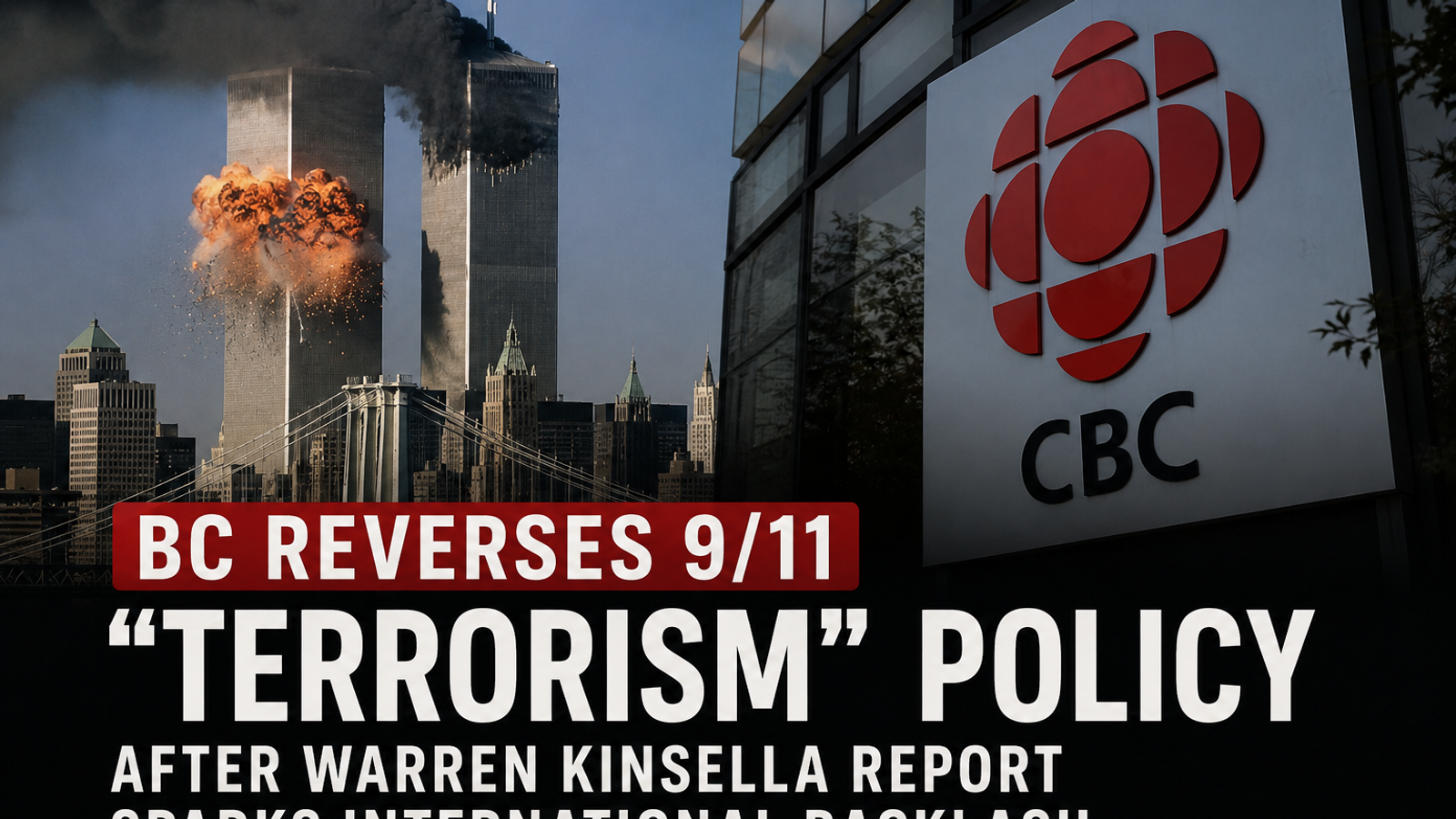


Canada’s public broadcaster has reversed its controversial guidance requiring journalists to avoid independently describing the September 11 attacks as “terrorism,” following a firestorm that began with reporting by Toronto columnist Warren Kinsella and quickly drew criticism from senior officials on both sides of the border.
Ahead of the 25th anniversary of the September 11, 2001 attacks, CBC News circulated internal guidance reminding journalists of its longstanding approach to the words “terrorist” and “terrorism.”
The directive was blunt: “Do not refer to the Sept. 11 attacks as terrorist attacks.”
Instead, CBC journalists were instructed to describe what occurred and, when using the term “terrorism,” attribute that characterization to governments, police, commissions or other authoritative sources.
The guidance may have remained an internal newsroom matter had it not been obtained and reported by Toronto Sun columnist Warren Kinsella.
From there, the controversy spread rapidly.
From Internal Memo to International Controversy
Kinsella’s reporting was picked up by media outlets in Canada and the United States, turning what CBC characterized as a longstanding journalistic practice into an international story.
FBI Director Kash Patel condemned the policy, calling it an insult to those killed in what he described as the largest terrorist attack in U.S. history.
U.S. Ambassador to Canada Pete Hoekstra also criticized the broadcaster, while Republican members of Congress weighed in.
In Canada, Conservative Leader Pierre Poilievre called on CBC to retract the directive and apologize.
The federal government also made clear that it did not share CBC’s hesitation over the terminology.
Public Safety Minister Gary Anandasangaree noted that Canada officially recognizes September 11 as a terrorist attack and pointed to the Anti-terrorism Act passed by Parliament following 9/11.
Canada’s position, he argued, was not merely political. The country’s laws and national security policies have treated the attacks as terrorism for nearly a quarter-century.
CBC Initially Defends Its Approach
CBC initially stood behind its policy.
The broadcaster explained that it had long exercised “extreme caution” when using terms such as “terrorist” and “terrorism,” preferring to attribute judgments about the motives behind politically or ideologically motivated violence to authoritative sources.
That policy attracted considerable controversy following Hamas’s October 7, 2023 attack on Israel, when CBC’s reluctance to independently describe Hamas members as “terrorists” became the subject of intense public debate.
CBC maintained that its approach did not mean denying that particular acts constituted terrorism. Rather, the broadcaster said it was a question of who should make that characterization.
But as criticism of the 9/11 directive mounted, CBC reconsidered.
CBC Reverses Course
By Friday afternoon, CBC News Senior Director of Journalistic Standards and Public Trust Basem Boshra announced that the broadcaster was changing its guidance specifically regarding 9/11.
“After reviewing our current language guidance, we have decided to adjust it to clarify that direct attribution is not required for describing the historic events of 9/11 as terrorism,” Boshra wrote.
He said the previous guidance had “unfortunately (and unintentionally) become an impediment to clarity and public understanding.”
CBC journalists can therefore now describe the September 11 attacks as terrorism directly, without having to attribute the characterization to an outside authority.
CBC stressed, however, that it had never denied that the attacks were terrorism.
“We have reported fully and accurately on the reasons and motivations for those attacks as determined by police, governments and an independent commission,” Boshra wrote, explaining that CBC had simply made sure to do so with attribution.
The broadcaster also indicated that its broader policy has not disappeared.
When new incidents of politically or ideologically motivated violence occur, CBC says it will continue its practice of attributing conclusions about causes and motivations to officials and experts.
Ottawa Welcomes the Reversal
Federal Culture Minister Marc Miller welcomed CBC’s decision — while offering unusually pointed criticism of the original guidance.
Miller called the reversal a “welcome change” from what he described as “pedantic and foolish guidance” that had caused legitimate anger.
The episode therefore ended with criticism of CBC coming not only from Conservatives and senior U.S. officials, but from the federal minister whose portfolio includes Canada’s public broadcaster.
A Larger Question for CBC
The controversy leaves CBC facing a broader question about its journalism.
If the September 11 attacks are now sufficiently established as terrorism that CBC journalists can use the word without attribution, at what point does that become true of other attacks?
The issue is particularly relevant following the debate surrounding CBC’s coverage of Hamas and the October 7 massacre in Israel.
CBC’s position is that careful attribution protects journalistic impartiality when motives and facts surrounding new acts of violence may still be contested.
Critics argue that there are circumstances in which excessive reluctance to use plain language can itself obscure reality.
For 9/11, at least, CBC has now concluded that its attribution requirement was doing more to confuse than clarify.
And the speed of the reversal is notable.
An internal directive was exposed by a Toronto columnist. The story spread internationally. Senior American officials, Canadian politicians and members of the federal government weighed in.
Within days, CBC changed the rule.