





On This Day in Jewish History: Chayei Adam
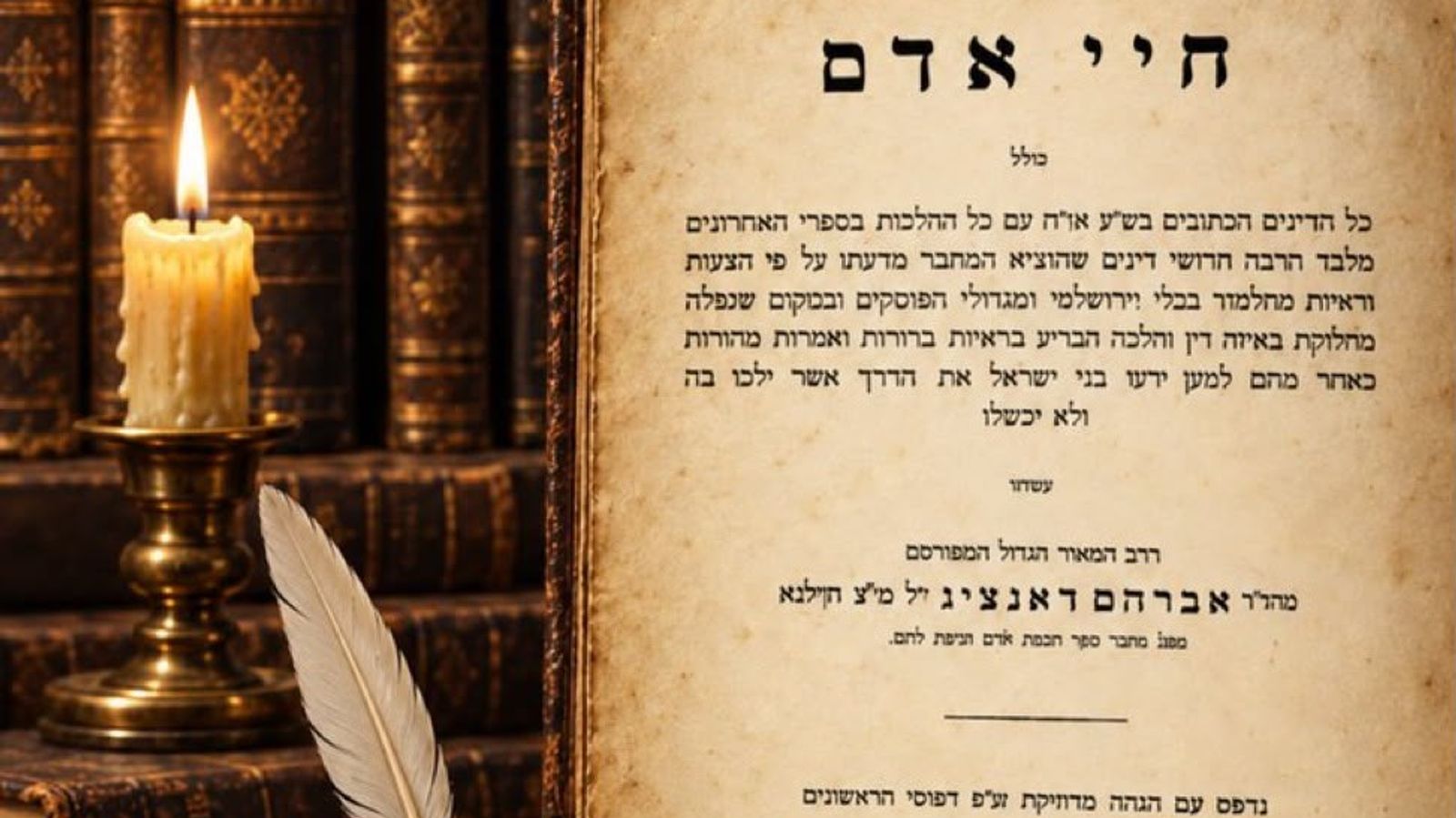


On this day in 1820, Rav Avraham Danzig passed away, making this day his yartzeit. He is known by the name of his great work, the Chayei Adam, which for a century served as the practical handbook of Jewish law for Lithuanian Jewry. Born in Danzig in 1748, he was sent at fourteen to learn in Prague under the Noda BiYehuda, but only after his father extracted a promise that he would not mingle with the maskilim then rising to prominence. He settled afterward in Vilna and refused the rabbinate there, earning his living instead as a merchant traveling to the fairs of Leipzig and Konigsberg. He accepted a seat on the rabbinical court only in his later years, after losing nearly his entire fortune.
The Chayei Adam appeared in 1810, a condensed summary of the laws of daily life, Shabbos, and the festivals, sifting two and a half centuries of halachic writing since the Shulchan Aruch. It was written deliberately for the educated layman rather than the scholar, in plain language with examples drawn from ordinary life. Rav Chaim of Volozhin, who opposed digests of halacha on principle, gave it his approbation anyway, on the condition that every section be cross-referenced to the Shulchan Aruch so a reader could go deeper. Towns across Lithuania formed societies to study it. The Chasam Sofer instructed his son that when he could not consult the Shulchan Aruch he could rely on Danzig's companion volume, the Chochmas Adam, and both works became foundational sources for the Kitzur Shulchan Aruch and the Mishnah Berurah.
Two other things he left behind are still with us. In 1804 a gunpowder magazine exploded in Vilna, killing thirty-one people and destroying his home and his business. His family survived, and in gratitude he established a private Purim for his descendants, a fast and extra charity on the fifteenth of Kislev followed by a thanksgiving meal the next night. And he composed Tefillah Zakah, the confession recited before Kol Nidrei, which Jews say every Yom Kippur. The merchant who would not take money for Torah gave the Jewish people both the book they lived by and the words they weep with.