





Tzom Gedaliah: the Final Chapter of the Churban
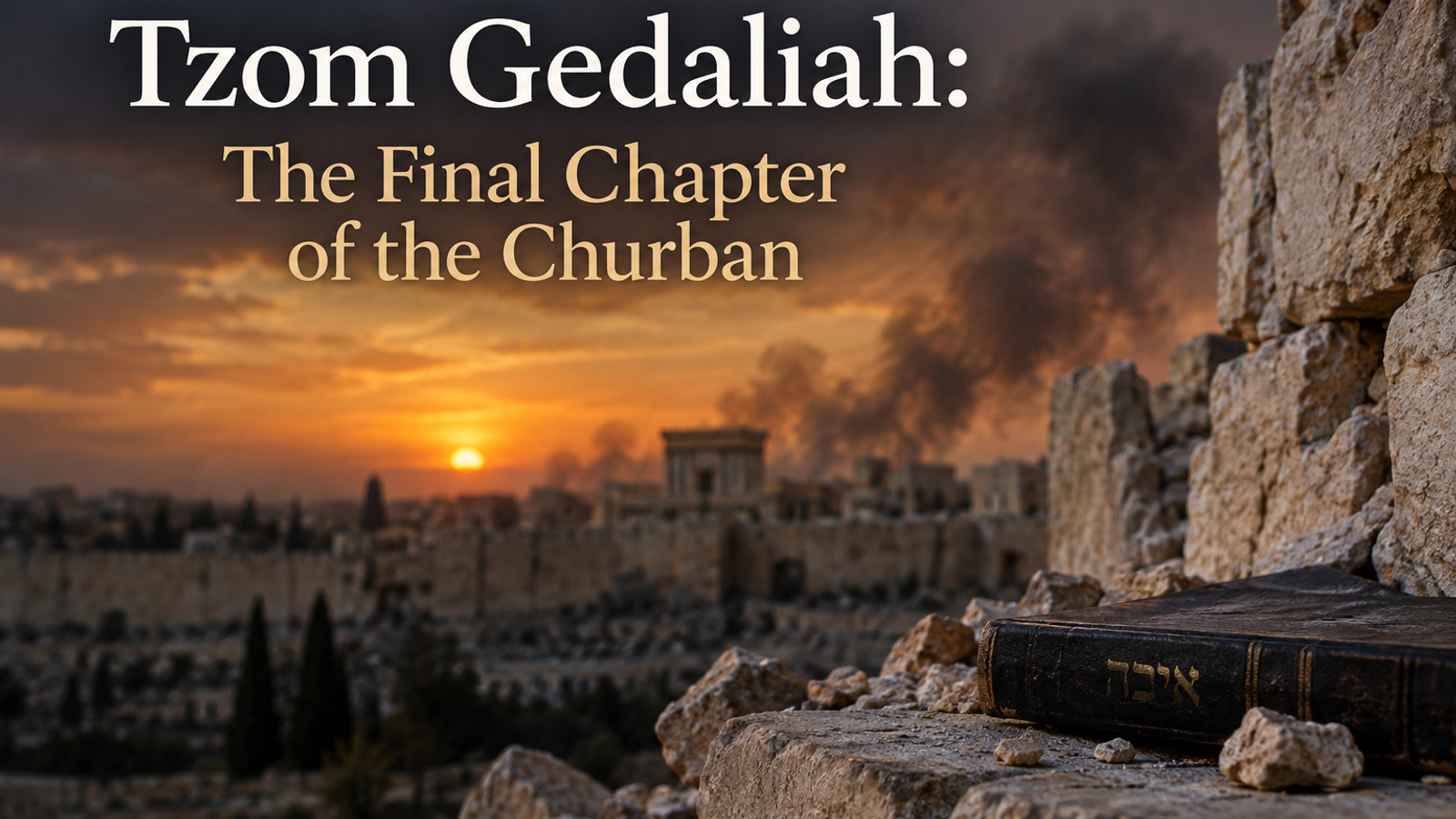


Every year, immediately following the two uplifting days of Rosh Hashanah, the Jewish calendar turns abruptly to a fast day: Tzom Gedaliah.
At first glance, its place among the major commemorations of the Churban is surprising. Asarah B’Teves marks the beginning of Nevuchadnetzar’s siege of Yerushalayim; Shivah Asar B’Tammuz commemorates the breaching of the city; and Tishah B’Av marks the destruction of the Beis HaMikdash.
Tzom Gedaliah commemorates the assassination of one man.
Why did that event merit a national fast observed by Jews thousands of years later?
The answer lies in what happened in Eretz Yisrael after the destruction of the first Beis HaMikdash. The Churban had occurred — but Jewish life in the land had not yet completely disappeared.
The Ember That Remained
After conquering Yerushalayim, the Babylonians exiled much of the Jewish population. But they left behind some of the poorer inhabitants of the country and appointed Gedaliah ben Achikam to govern the remaining population from the administrative outpost in the city of Mitzpah.
Gedaliah was no obscure figure. His father, Achikam ben Shafan, had previously intervened to save Yirmiyahu HaNavi’s life when others wanted him killed. Yirmiyahu himself now joined Gedaliah in Mitzpah.
Gedaliah faced the enormous task of leading the shattered remnants of a nation. His message was pragmatic: Do not rebel against Bavel. Accept Babylonian rule, work the land and rebuild what can be rebuilt.
Remarkably, it began to work.
When Jews who had fled to Moav, Ammon, Edom and other surrounding areas heard that Nevuchadnetzar had left a Jewish remnant in Yehudah and appointed Gedaliah over them, they began returning. They harvested wine and summer fruits in abundance.
The Beis HaMikdash was gone and the kingdom of Yehudah had fallen, but Jews were still living together in Eretz Yisrael under Jewish leadership.
Amid the ruins, a small ember remained.
The Warning Gedaliah Wouldn’t Believe
That fragile recovery would not last.
Among the military leaders who came to Gedaliah was Yishmael ben Nesanyah. Yishmael was not simply another soldier. Tanach describes him as being mi’zera hameluchah — a descendant of the royal family.
Yochanan ben Kareach approached Gedaliah with alarming information. He told him that Baalis, king of Ammon, had sent Yishmael to assassinate him.
Gedaliah refused to believe it.
Yochanan then privately offered to kill Yishmael before he could carry out the plot, arguing that Gedaliah’s assassination would cause the Jewish population that had gathered around him to scatter.
Yet Gedaliah prohibited him from doing so.
His response was unequivocal: “What you are saying about Yishmael is false.”
Tragically, the warning was correct.
Murder at the Table
In the seventh month — Tishrei — Yishmael arrived in Mitzpah accompanied by ten men.
Gedaliah welcomed them. They sat down and ate bread together.
Then, in an extraordinary act of betrayal, Yishmael and his men rose from the table and murdered Gedaliah — the very man who had welcomed them as guests.
They also killed the Jews who were with Gedaliah and the Babylonian soldiers stationed there. The violence continued afterward, with Yishmael killing additional Jews before eventually fleeing toward Ammon.
The consequences of Gedaliah’s murder went far beyond the loss of one leader.
The remaining Jews were terrified. Gedaliah had been appointed by Nevuchadnetzar himself, and now he and the Babylonian personnel around him had been murdered. The population feared Babylonian retaliation.
Despite Yirmiyahu HaNavi’s subsequent warning not to leave the land, the surviving community ultimately fled toward Egypt.
The Rambam sums up the significance of the assassination with a haunting expression:
“The remaining ember of Yisrael was extinguished, causing their exile to become complete.”
That description is the key to understanding Tzom Gedaliah.
The fast is not simply a memorial to a murdered Jewish governor. It commemorates the collapse of the fragile Jewish restoration that had survived the Churban.
Why the Third of Tishrei?
Yirmiyahu describes the assassination as occurring “in the seventh month,” meaning Tishrei, while the Gemara identifies the “fast of the seventh” mentioned by Zechariah HaNavi as Tzom Gedaliah.
There is an intriguing discussion regarding the precise date.
The Radak understands that Gedaliah was actually killed on Rosh Hashanah itself. According to this understanding, since a public fast could not be held on Rosh Hashanah, its observance was placed immediately afterward. Other sources understand the third of Tishrei itself to have been the date of the assassination.
Either way, Tzom Gedaliah became permanently embedded in the Jewish calendar immediately following Rosh Hashanah.
“The Death of Tzaddikim Is Like the Burning of the Beis HaMikdash”
The Gemara in Rosh Hashanah draws an additional lesson from the establishment of the fast.
Why is the murder of Gedaliah commemorated alongside events such as the destruction of the Beis HaMikdash?
Chazal answer:
“Shekulah misasan shel tzaddikim kisreifas Beis Elokeinu” — the death of tzaddikim is comparable to the burning of the House of Hashem.
Gedaliah’s death was therefore not merely a political catastrophe. The loss of a tzaddik and leader of Klal Yisrael is itself viewed by Chazal as a form of Churban.
Gedaliah’s Mistake — And a Lesson About Lashon Hara
There is another remarkable element of the story.
Gedaliah had been warned.
Wasn’t his refusal to accept a negative report about Yishmael admirable? Isn’t a Jew supposed to be exceedingly cautious about believing lashon hara?
The Gemara in Niddah derives an important lesson from precisely this episode.
Tanach describes victims whom Yishmael had killed as having been killed “through Gedaliah.” The Gemara asks: Did Gedaliah kill them? Yishmael killed them!
Chazal explain that because Gedaliah should have taken Yochanan’s warning into consideration and failed to do so, the consequences are attributed to him.
Rava therefore derives a crucial distinction regarding lashon hara: one should not simply accept a negative report as fact, but when the information concerns a genuine potential danger, one must nevertheless take appropriate precautions.
Gedaliah did not have to condemn Yishmael based on an unverified accusation. But neither could he safely ignore a credible warning that his life — and potentially the future of the remaining Jewish community — was in danger.
It is a striking lesson contained within the history of the fast: refusing to believe lashon hara does not require ignoring a possible danger.
Tzom Gedaliah and the Aseres Yemei Teshuvah
There is another dimension to Tzom Gedaliah that is difficult to overlook: its place on the Jewish calendar.
Immediately after Rosh Hashanah, the first weekday of the Aseres Yemei Teshuvah is a fast day.
Tzom Gedaliah was established because of the historical catastrophe, not simply because it falls during the Aseres Yemei Teshuvah. Nevertheless, its timing carries a powerful message.
The Rambam explains that the purpose of the fast days is not merely to remember tragedies of the distant past. Recalling the destructive actions of earlier generations and the calamities that followed is supposed to awaken us to teshuvah and cause us to examine our own conduct.
There could hardly be a more appropriate message for the days between Rosh Hashanah and Yom Kippur.
And the history of Tzom Gedaliah adds another dimension: the tragedy of a second chance that was lost.
The Jewish people had suffered an almost unimaginable Churban. Yet they had been given an opportunity to begin again. Jews were returning to the land, gathering around Gedaliah and rebuilding their lives.
Then that fragile opportunity was destroyed from within.
That gives Tzom Gedaliah particular resonance immediately after Rosh Hashanah.
Rosh Hashanah teaches us that a new year can begin. Tzom Gedaliah reminds us that a new beginning can also be lost.
We have just stood before Hashem and been given another opportunity: another year in which to change, repair relationships, correct mistakes and become the people we are capable of becoming.
Almost immediately, Jewish history confronts us with the story of an opportunity for renewal that slipped away.
Perhaps that is one of the messages to carry from Tzom Gedaliah through the remainder of the Aseres Yemei Teshuvah: being given another chance is precious — but what ultimately matters is what we do with it.
The Final Chapter of the Churban
Tzom Gedaliah thus completes a tragic historical progression:
- Asarah B’Teves: the siege begins.
- Shivah Asar B’Tammuz: the walls are breached.
- Tishah B’Av: the Beis HaMikdash is destroyed.
- Tzom Gedaliah: the remaining Jewish settlement established after the Churban collapses.
And yet Zechariah HaNavi places Tzom Gedaliah alongside those same fasts when delivering one of the great promises of Jewish history: the days that commemorate the Churban will ultimately become days of joy and celebration.
The story of Tzom Gedaliah is therefore much more than the story of an assassination.
It is the story of a shattered nation that was given an opportunity to begin again — and of how quickly that opportunity was lost.
The Beis HaMikdash had already burned.
Tzom Gedaliah marks the extinguishing of the ember that remained.