






Cbc Faces Questions After Jewish Journalist Reportedly Disciplined for Documenting Yom Kippur Protest
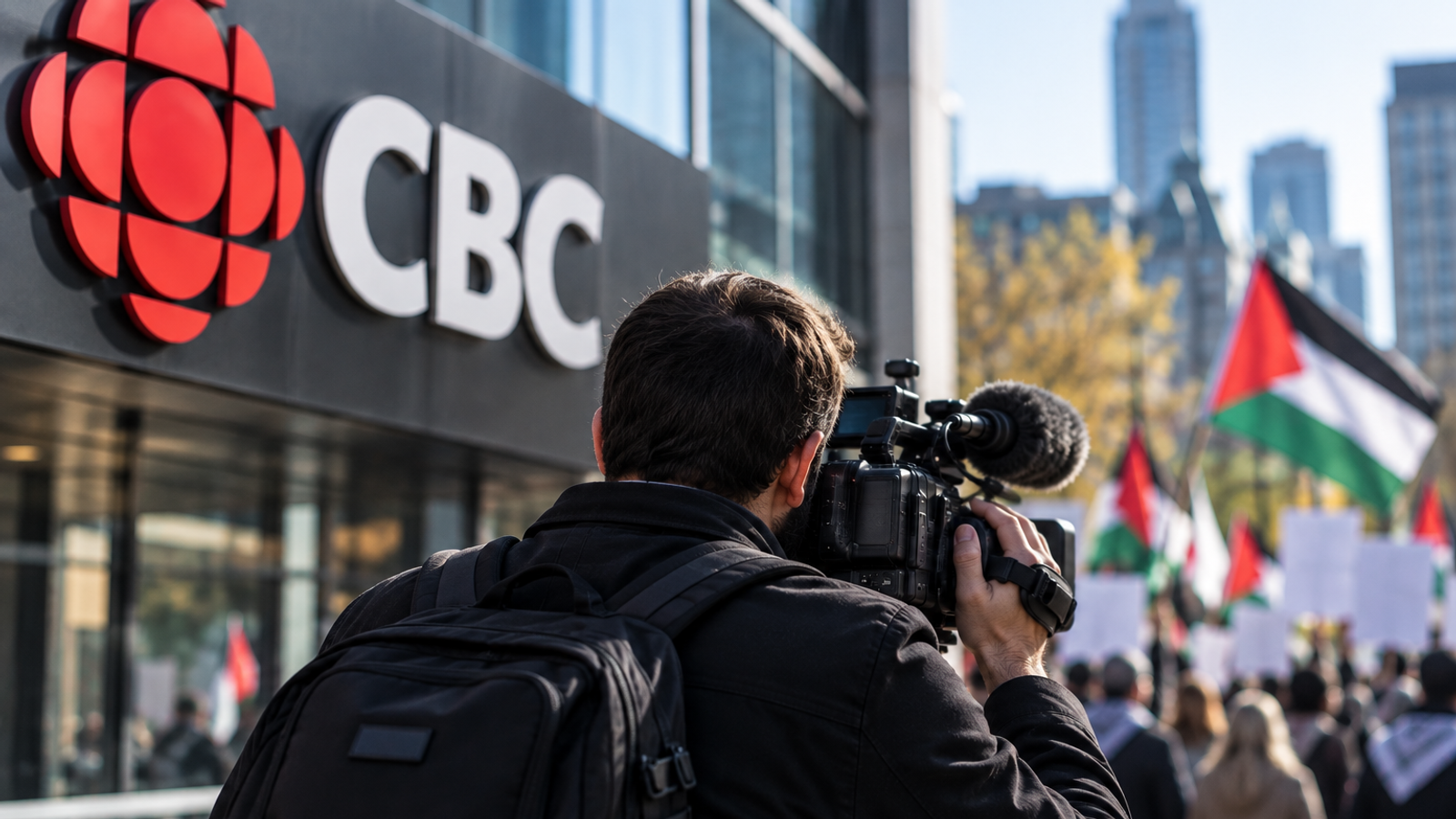


Veteran CBC journalist Neil Herland was reportedly pulled off the air after posting footage of protesters outside a Toronto Yom Kippur service, prompting former CBC journalists — including Travis Dhanraj — to raise questions about whether the broadcaster is applying its own standards consistently.
A controversy surrounding veteran CBC journalist Neil Herland is growing beyond the disturbing scenes he documented outside a Toronto Yom Kippur service, with former CBC journalists and press groups now questioning the broadcaster's reported response.
Herland, an award-winning CBC journalist and producer with roughly three decades of experience, was attending The Song Shul's Yom Kippur services at the Meridian Arts Centre in North York on September 21 when he encountered a group of pro-Palestinian protesters outside.
Former Israeli diplomat Mark Regev was appearing as a guest speaker during the program, and protesters have maintained that his presence was the reason for their demonstration.
But the event was also The Song Shul's Yom Kippur religious service, and Herland's footage captured confrontations involving people arriving at the venue.
In a video posted to his personal X account, protesters can be heard shouting "Zionist alert," while one man repeatedly directs a bullhorn toward Herland and tells him, "You're going to hell." Other abusive remarks were also reported by congregants.
"I'm a journalist. And I happen to be Jewish."
Herland subsequently posted a deeply personal account of the encounter.
"I'm a journalist. And I happen to be Jewish," he wrote, explaining that he had gone to a synagogue service and encountered protesters whom he said were attempting to "taunt and intimidate" him from entering.
Herland wrote about his late father, an Austrian Jew who survived the Holocaust in Romania before coming to Canada as a refugee. He also disclosed that he had obtained an Austrian passport this year because of his concern that Canada could someday become unsafe for him as a Jew.
"Jewish Canadians are living in a parallel world," Herland wrote, describing armed police outside synagogues and attacks targeting Jewish schools, religious institutions and businesses.
His video was subsequently viewed millions of times.
Activist group files complaint
Canadians for Justice and Peace in the Middle East (CJPME) strongly objected to Herland's account and launched a campaign calling for action by CBC.
The organization filed complaints with CBC's Ombud and Values and Ethics Commissioner, arguing that Herland had misrepresented a protest aimed at Regev as an attempt to intimidate Jewish worshippers.
CJPME also argued that Herland's social-media commentary violated CBC journalistic standards because he publicly identifies himself as a CBC journalist while expressing views about a contentious political issue.
The organization called for CBC to require Herland to remove the posts and issue a retraction.
There is an important distinction at the heart of that dispute: Regev's presence may have prompted the protest, but The Song Shul was simultaneously holding its Yom Kippur services at the venue.
A representative of The Song Shul said that some congregants were so frightened by the demonstration that they remained in their cars and ultimately went home rather than attend the Yom Kippur service.
Many have defended Herland's recording as an accurate depiction of what congregants encountered.
Herland reportedly pulled off air
Toronto Sun columnist Warren Kinsella subsequently reported that CBC had pulled Herland off the air, informed him that he was being investigated, and held an initial disciplinary meeting with Herland and his lawyer.
CBC has not publicly confirmed those specific details.
The broadcaster has said it does not comment on internal meetings or human-resources matters and has told other media that some reporting about the situation contains "errors and mischaracterizations," without specifying what those errors are.
Herland himself has declined to publicly discuss the disciplinary proceedings on the advice of his lawyer.
As a result, it remains unclear exactly what action CBC has taken against Herland, what specific rule it believes may have been violated, or whether the CJPME complaint prompted the reported disciplinary process.
Travis Dhanraj: "The double standard is appalling"
The controversy took another turn when former CBC journalist Travis Dhanraj publicly defended Herland and raised questions about CBC's treatment of journalists' personal experiences.
Dhanraj pointed to an earlier CBC Ombudsman decision affirming that "journalists' lived experiences and community connections can coexist with journalistic standards."
CBC has previously stated that belonging to a particular community does not itself constitute a conflict of interest and that the lived experiences of journalists can help "broaden and deepen" its journalism.
Dhanraj argued that this principle appears difficult to reconcile with the reported response to Herland.
"The double standard is appalling," he wrote.
Dhanraj, who has himself been involved in a public dispute with CBC since leaving the broadcaster, noted that Herland was among the colleagues who reached out to him during his own difficulties with CBC.
"Neil Herland belongs back on the air," Dhanraj wrote, while expressing hope that Herland's union was defending him.
Press groups enter the controversy
The Independent Press Gallery has now also spoken out in support of Herland, despite the CBC journalist not being one of its members.
The organization argued that documenting a public event is a fundamental journalistic activity and expressed concern about a journalist potentially facing consequences following pressure from an activist organization.
The Independent Media Union has similarly called on other Canadian journalism organizations and Herland's union to address the situation.
A larger question for CBC
The controversy ultimately involves several separate issues.
There is little dispute that Regev's appearance was relevant to why protesters were present. At the same time, there is also little dispute that The Song Shul was conducting Yom Kippur services at the venue and that Jewish congregants — many of whom were unaware of Regev's scheduled appearance — were accosted by protesters while attempting to attend those services.
CBC has not publicly disclosed the allegations being considered internally, confirmed the precise disciplinary measures reportedly imposed on Herland, or explained what it considers inaccurate in media reports about the case.
Until it does, the central question surrounding the controversy remains unanswered: what exactly did Neil Herland do that CBC believes "warranted an investigation," and would the same standard be applied to another CBC journalist documenting an incident involving their own community?