





Did the United Arab Emirates Warn Netanyahu Before October 7? Inside the Explosive Claim Shaking Israel
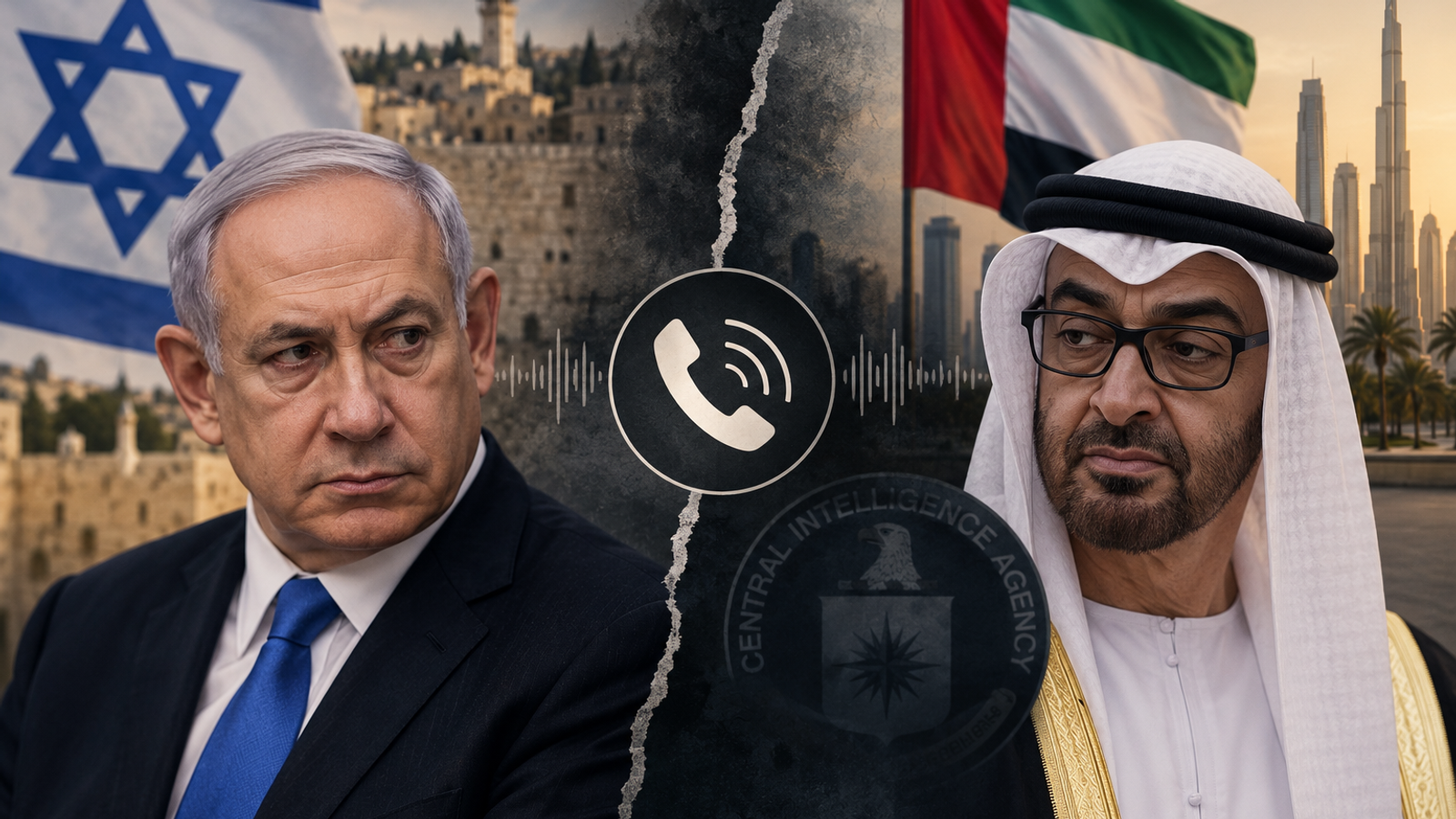


A bombshell report alleging that Israeli Prime Minister Benjamin Netanyahu received a personal warning from the president of the United Arab Emirates shortly before the October 7 massacre — and failed to pass it on to Israel’s security chiefs — has set off a fierce political and factual battle in Israel.
Netanyahu has issued an unusually categorical denial, saying not merely that the warning has been exaggerated, but that the alleged conversation never took place. He has now instructed his lawyers to sue Haaretz and journalist Shlomi Eldar over the report.
Yet the allegation has not disappeared. An Emirati source has reportedly corroborated that a warning was delivered, former prime minister Naftali Bennett says he knows the report to be true, and the UAE government itself has conspicuously declined to either confirm or deny the alleged conversation.
At the same time, newly reported information concerning former CIA director William Burns raises the possibility of a third version: that UAE President Sheikh Mohamed bin Zayed did speak to Netanyahu before October 7 and did issue a warning — but that the warning may have been considerably more general than Haaretz reported.
So what do we actually know?
The Bombshell Allegation
The controversy began with an extensive Haaretz investigation based on reporting by Israeli journalists Shlomi Eldar and Ruth Yuval for their forthcoming book, Kidnapped: 843 Days of Abandonment.
According to their account, approximately 10 days before October 7, 2023, Mohamed bin Zayed — commonly known as MBZ — spoke with Netanyahu for approximately 45 minutes.
The Emirati president allegedly warned Netanyahu that Hamas leader Yahya Sinwar was preparing a major operation against Israel, one that could result in significant bloodshed, destabilize the Middle East and threaten the Abraham Accords.
The warning reportedly originated in messages Sinwar had conveyed through Palestinian intermediaries. According to the investigation, Sinwar had spoken ominously of an approaching “zilzal” — Arabic for “earthquake” — and of preparing an extraordinary surprise for Israel.
Importantly, there is no allegation that MBZ possessed the detailed October 7 operational plan or told Netanyahu that Hamas would invade southern Israel on October 7 at a particular time.
Rather, the central allegation is that Netanyahu was warned that Sinwar was preparing a major Hamas operation.
According to the report, Netanyahu was relatively unfazed. He allegedly told MBZ that Israel was prepared for any scenario and believed the more volatile arena was the West Bank rather than Gaza.
Perhaps most consequentially, Haaretz reported that Netanyahu did not subsequently tell senior Israeli security officials about the conversation. Former Shin Bet chief Ronen Bar and former IDF chief of staff Herzi Halevi reportedly said they had not been informed of such a warning.
Ten days later, Hamas launched the deadliest attack in Israeli history.
Netanyahu: It Never Happened
Netanyahu’s response has been unequivocal.
His office initially described the allegation as an “absolute lie,” saying Netanyahu did not speak with MBZ during the period in question and received no warning from him. It later stated that no UAE warning was given to the prime minister and that any relevant intelligence would have been transmitted through the established intelligence channels between the two countries.
On Wednesday, Netanyahu went further.
He said his staff had checked the records and found no Netanyahu-MBZ conversation between the beginning of September 2023 and October 7. Such a conversation, Netanyahu argued, would necessarily have left documentation.
He called the report a “sinister libel” timed to Israel’s election campaign and announced that he had instructed his lawyers to sue Haaretz, Eldar and potentially others involved in publishing the allegation.
That leaves remarkably little room for reconciliation between Netanyahu’s account and the original report.
This is not a dispute over whether MBZ’s warning was specific enough, or whether Netanyahu properly understood it.
Netanyahu says the alleged call itself did not happen.
But There Is Corroboration
The case does not rest solely on the original Haaretz article.
The Times of Israel subsequently reported that an Emirati source familiar with the conversation independently confirmed that the warning occurred during a phone call between MBZ and Netanyahu.
Eldar has also said that the reporting was based on three independent sources as well as a recording and documents relating to the conversation, according to The New Yorker.
Then there is Naftali Bennett.
The former Israeli prime minister said publicly that he knows “for a fact” that the report is true. Bennett claimed that MBZ warned Netanyahu that Sinwar was planning an operation and further asserted that Abbas Kamel, then the head of Egyptian intelligence, separately warned Netanyahu that a major operation was being planned.
Bennett did not publicly disclose how he knows this information.
The UAE Isn't Confirming It — But Isn't Denying It Either
With Netanyahu explicitly saying the call never happened, attention quickly turned to Abu Dhabi.
The UAE could theoretically have resolved at least part of the dispute with a straightforward statement saying whether its president spoke with Netanyahu.
It declined to do so.
The UAE Foreign Ministry said it would not comment on speculation regarding conversations between government leaders. It noted instead that Israel and the UAE have maintained direct communications since establishing relations and that relevant intelligence is exchanged when necessary.
According to The Jerusalem Post, Emirati officials have indicated that Abu Dhabi does not view itself as responsible for responding to every Israeli media report and does not intend to become involved in Israel’s election campaign or function as the Israeli government’s public-relations arm.
The UAE’s silence therefore cannot fairly be described as confirmation.
But neither is it the categorical denial Netanyahu has offered.
The William Burns Wrinkle
Perhaps the most intriguing new development concerns what MBZ reportedly told William Burns, who was CIA director at the time.
The original reporting claimed that MBZ was sufficiently concerned by Netanyahu’s response that he subsequently raised the matter with Burns.
But The Jerusalem Post has now reported a somewhat different version based on a source familiar with the matter.
According to that source, MBZ did speak to Burns after October 7 and referred to a conversation he had held with Netanyahu before the attack.
That, if accurate, is significant in itself because it would appear to support the existence of a pre-October 7 Netanyahu-MBZ conversation.
However, the source characterized what MBZ said he had conveyed to Netanyahu as a general warning about the volatile situation on the ground, rather than a specific warning that Hamas was preparing an imminent war or major attack.
That creates a potentially important middle ground.
It could mean that Haaretz is substantially correct that MBZ warned Netanyahu, while the specificity and urgency attributed to the warning have been overstated.
Alternatively, the various accounts could be describing different conversations or recollections. Without contemporaneous records being made public, that remains unresolved.
And Then Antony Blinken Challenged Another Part of the Story
Another complication has emerged from former U.S. Secretary of State Antony Blinken.
The Haaretz investigation also contained an allegation concerning events after the Hamas attack had already begun, separate from the UAE warning.
According to that account, Qatar’s prime minister contacted Blinken on October 7 and said Qatar could attempt to mediate the rapid release of civilian hostages taken into Gaza but that Israel was not interested.
The article attributed a response to Blinken essentially urging that they wait while he spoke with Netanyahu.
Blinken has now publicly rejected that account, calling the quotation attributed to him “false” and “complete fiction.”
Blinken’s denial does not directly disprove the UAE-Netanyahu allegation — the two claims concern different conversations.
But it does matter when assessing the broader investigation: a former U.S. secretary of state is categorically disputing the accuracy of another reconstructed high-level conversation contained in the same reporting.
Meanwhile, The Jerusalem Post reports that two sources familiar with the matter said senior Biden administration officials were not aware of the UAE having given Netanyahu a specific warning of an impending Hamas attack, either before or after October 7.
Why This Matters
The controversy cuts directly to one of the central unresolved questions surrounding October 7: Who knew what — and when?
For nearly three years, Israel’s political and security leadership have battled over responsibility for the catastrophic failure that allowed thousands of Hamas terrorists to cross the Gaza border.
Netanyahu has repeatedly emphasized the failures of Israel’s intelligence and security establishment, including the failure to alert him during the critical hours immediately preceding the attack.
The new allegation potentially turns that argument around.
If Netanyahu personally received a warning from one of Israel’s most important Arab allies that Sinwar was preparing a major operation — and failed to tell Israel’s security chiefs — it would represent an extraordinary new element in the October 7 failure.
If, however, the alleged 45-minute call never occurred, as Netanyahu insists, then Haaretz has published an extraordinarily serious accusation against a sitting Israeli prime minister on the eve of an election.
And if the Burns account proves closest to reality — that MBZ did speak with Netanyahu and issued only a broad warning about regional instability — then the truth may fall somewhere between those two stark versions.
What We Know — And What We Don't
At this point, it would be premature to state as established fact that “Netanyahu was warned about October 7.”
There is no publicly available transcript or call record showing MBZ telling Netanyahu that Hamas was preparing the attack that ultimately occurred.
But the allegation is also no longer easily dismissed as an unsupported newspaper claim.
The original journalists say they relied on multiple sources and supporting material. An Emirati source reportedly confirmed the warning to The Times of Israel. Bennett says he knows the account is true. The UAE has declined to deny it. And the reported Burns conversation may independently support the existence of some kind of pre-October 7 warning from MBZ — although potentially a much less specific one.
Against all of that stands Netanyahu’s unequivocal response: there was no such call, there was no UAE warning, the records prove it — and he is prepared to fight the allegation in court.
That makes this more than another dispute over how to interpret the intelligence failures preceding October 7.
Someone’s account of what happened inside one of the most consequential conversations — or alleged conversations — preceding the massacre is fundamentally wrong.
Determining whose may now become part of Israel’s broader reckoning over October 7.