






The Altalena Has Been Found: the Shipwreck That Still Haunts Israel 78 Years Later
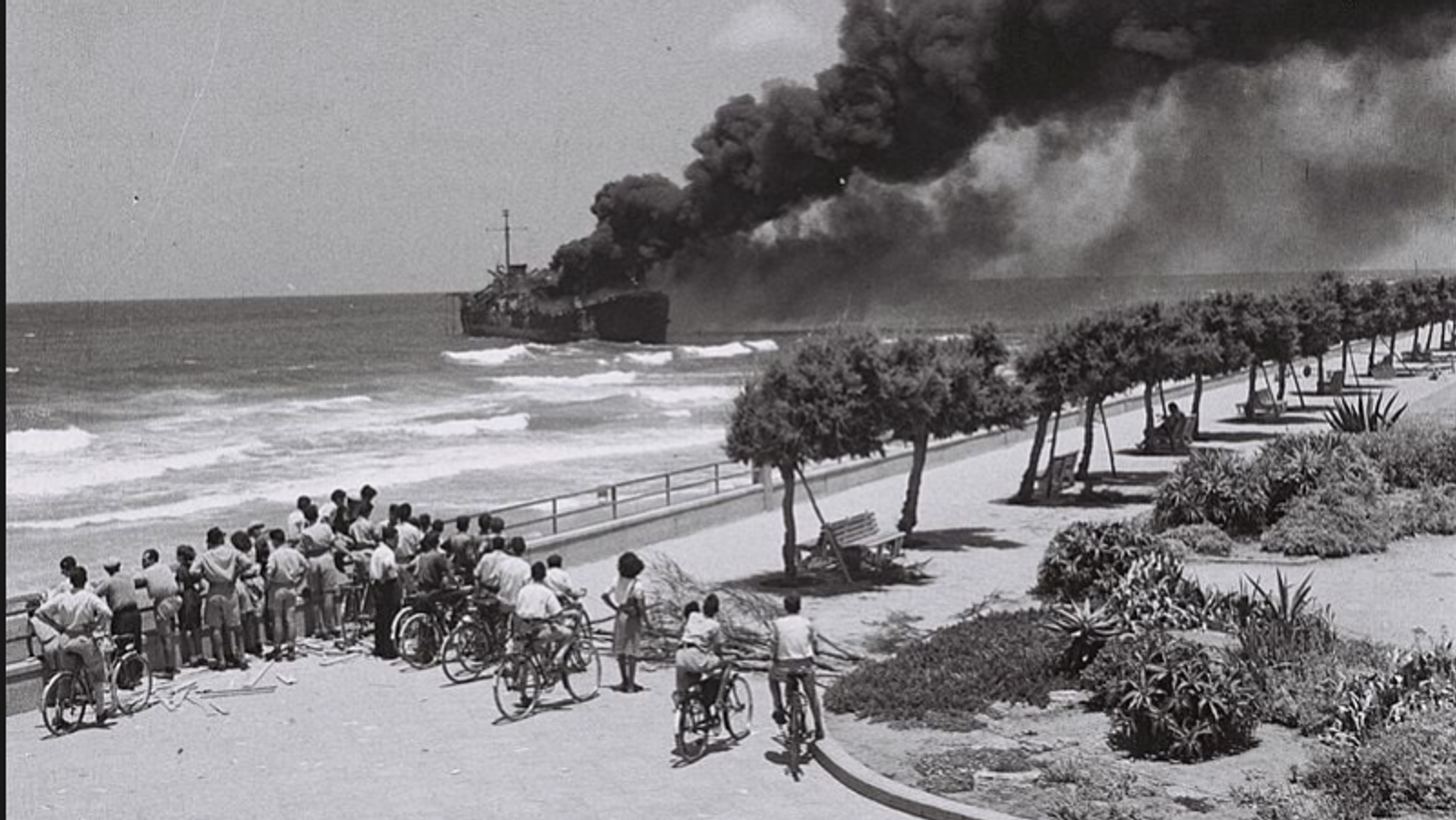


Nearly eight decades after one of the most traumatic episodes in Israel's founding, the wreck of the Altalena has been located deep beneath the Mediterranean. Its discovery is reopening an extraordinary story of weapons, politics, Menachem Begin, David Ben-Gurion, and the moment the newborn Jewish state came perilously close to civil war. Now Israel faces a new question: What might the ship itself reveal?
Seventy-eight years after the Altalena became a burning symbol of one of the deepest divisions in Israeli history, Israel has found the ship.
The wreck was located early Monday morning approximately 20 kilometres off Israel's Mediterranean coast, at a depth of 503 metres—roughly 1,650 feet. According to Israeli officials, the vessel appears to be remarkably intact. The discovery followed months of planning and a sophisticated maritime search using specialized sensors and advanced survey equipment.
For most shipwrecks, that would make for an intriguing archaeological discovery.
The Altalena is something altogether different.
The ship lies at the centre of an episode that shaped Israeli democracy, the relationship between civilian government and the military, and the bitter political rivalry between the country's Labor and Revisionist camps for generations.
It is also the story of the moment when Jews actually opened fire on other Jews in the middle of Israel's War of Independence—and of Menachem Begin's decision that, whatever happened next, there would be no Jewish civil war.
A Ship Full of Weapons for a Country Fighting for Its Life
To understand the Altalena, it is necessary to return to the extraordinary circumstances of the spring of 1948.
The State of Israel was proclaimed on May 14.
But the Jewish community that became Israel did not enter independence with a single unified military.
The Haganah was the largest pre-state Jewish military organization and was associated with the mainstream Zionist leadership headed by David Ben-Gurion. The Palmach operated as its elite strike force.
The Irgun, or Etzel, was a separate underground organization associated with the Revisionist Zionist movement founded by Ze'ev Jabotinsky. Its commander was Menachem Begin, who three decades later would become Israel's first Likud prime minister.
Lehi, sometimes known as the Stern Group, was another independent underground.
Once Israel became a state, Ben-Gurion believed this arrangement could not continue.
A sovereign country, he insisted, could have only one government and one army.
The Israel Defense Forces were formally established in late May. On June 1, Begin and the provisional government reached an agreement integrating the Irgun's approximately 10,000 fighters into the new IDF. Irgun forces in Jerusalem remained a special exception because the city's status had not yet been settled.
But another Irgun project was already underway.
The organization had acquired a former American landing ship, the USS LST-138, and renamed it Altalena—the literary pseudonym used by Jabotinsky.
The ship was being prepared in Europe to bring immigrants, fighters, and a massive quantity of desperately needed military equipment to the new Jewish state. Its voyage had been conceived before the Irgun's absorption into the IDF.
Its delayed arrival proved fateful.
By the time the Altalena sailed from France on June 11, Israel existed, the IDF existed, and Begin had agreed that the Irgun would cease functioning as an independent military organization. The ship carried roughly 900 immigrants and volunteers along with a major shipment of rifles, machine guns, ammunition, explosives, and other weapons.
There was another complication: a United Nations-brokered truce had begun on June 11, prohibiting the importation of weapons and military personnel.
Nevertheless, the Israeli government knew that the ship was coming. Negotiations were underway over where it would land and, critically, what would happen to its weapons.
The Dispute That Changed Israeli History
The fundamental argument was over who had the right to decide where those weapons went.
Begin wanted 20 percent allocated to Irgun fighters in Jerusalem, who had not yet been incorporated into the IDF.
The larger dispute concerned the remainder.
Begin sought to have weapons allocated to the former Irgun battalions now serving within the IDF. From the Irgun perspective, these were no longer private soldiers—they were IDF troops, and the weapons obtained through enormous effort overseas could equip them for the ongoing war.
Ben-Gurion saw a dangerous precedent.
If Begin could bring weapons into the country and determine which military units received them, then the Irgun continued to exercise an independent military authority.
To Ben-Gurion, that meant an "army within an army."
This distinction is at the heart of the historical argument that continues to this day.
Begin's defenders maintain that he had already accepted the authority of the new state, dissolved his independent organization into the IDF, and was negotiating over how weapons intended to defend Israel would be distributed.
Ben-Gurion's defenders argue that the issue was larger than Begin's intentions: a sovereign democratic government simply could not permit a political movement to independently import and allocate military weapons.
Both sides understood the dispute as something much larger than a shipment of rifles.
Kfar Vitkin: Jews Open Fire on Jews
The Altalena arrived off Kfar Vitkin, north of Netanya, on June 20, 1948.
Its passengers came ashore and the unloading of weapons began.
Accounts commonly report that approximately 2,000 rifles, two million rounds of ammunition, 200 Bren guns, and 3,000 shells were brought ashore before the confrontation reached its climax.
The provisional government met.
Ben-Gurion was adamant that the state could not accept an independently controlled arms shipment. The government authorized the IDF to take control of the situation, using force if necessary.
The Alexandroni Brigade surrounded Kfar Vitkin.
Its commander, Dan Even, delivered Begin an ultimatum: surrender the ship and its weapons to the IDF.
Begin was given approximately ten minutes to respond.
The ultimatum was not accepted.
Then the shooting began.
Exactly how responsibility should be apportioned for the first shots and the subsequent escalation has remained part of the historical dispute.
The results, however, are not disputed: Six Irgun members and two IDF soldiers were killed.
A ceasefire was eventually reached. Weapons already brought ashore were transferred to the IDF.
But the Altalena still contained a large quantity of weapons.
And Begin boarded the ship.
It sailed south.
Toward Tel Aviv.
The Altalena Appears Off Tel Aviv
From Begin's perspective, there was still hope that negotiations could resolve the crisis.
From Ben-Gurion's perspective, an armed vessel controlled by an organization that had just fought the IDF was now approaching the political centre of the country.
The ship reached Tel Aviv and eventually ran aground just offshore.
Word spread rapidly.
Irgun supporters and former fighters gathered. IDF forces moved into position. Exchanges of fire erupted.
Israel had been independent for barely five weeks.
Its soldiers were fighting Arab armies for the survival of the country.
And now Jews were shooting Jews on the beaches of Tel Aviv.
The National Library of Israel describes the Altalena affair as a crisis that brought the newborn country to the brink of civil war.
Ben-Gurion Gives the Order
Ben-Gurion would not permit the ship to remain under independent Irgun control.
IDF artillery was positioned on shore.
According to the National Library's reconstruction, one artilleryman initially refused an order to fire on fellow Jews. Another ultimately fired.
A shell struck the Altalena.
The ship caught fire.
There were large quantities of ammunition and explosives aboard, making the spreading flames particularly terrifying.
Captain Monroe Fein ordered the evacuation of the vessel. Men jumped into the Mediterranean and attempted to reach shore.
Begin remained aboard until late in the evacuation.
The fighting in Tel Aviv killed another ten Irgun members and one IDF soldier.
Together with the deaths at Kfar Vitkin, the Altalena affair claimed 19 Jewish lives: 16 Irgun members and three IDF soldiers.
Begin's Decision
What happened next became perhaps the most enduring part of Begin's legacy.
His men were furious.
Their comrades were dead. Their weapons ship was burning. The new Israeli government had turned artillery against them.
The Irgun still had thousands of armed members and sympathizers around the country.
Begin could have called upon them to fight.
He did the opposite.
He ordered his followers not to retaliate.
His words were broadcast over the Irgun radio station as the Altalena burned. The Knesset's official biography of Begin credits his restraint with preventing an armed response that could have led to civil war.
The principle became inseparable from the Altalena story:
"Milchemet achim—lo."
A war between brothers—no.
Begin himself would later regard preventing civil war as one of his greatest achievements.
Ben-Gurion's Principle
But the episode left Israel with another foundational principle as well.
Whatever one thinks about Ben-Gurion's decision to use artillery against the Altalena, his underlying argument prevailed.
There would be one Israeli army.
No political party or ideological movement would possess its own military force.
The Haganah, Palmach, Irgun, and Lehi would disappear as independent armed organizations. The IDF would answer to Israel's elected government.
For Ben-Gurion's defenders, the Altalena was therefore the painful but decisive moment in which the new state established its monopoly over armed force.
For Begin's followers, it became something very different: a symbol of the old Mapai establishment's willingness to use extraordinary force against its Revisionist rivals.
Those competing interpretations would follow Israeli politics for decades.
From Altalena to Likud
Begin entered democratic politics and founded Herut, the political heir to the Revisionist movement. In Israel's first Knesset election in 1949, Herut won 14 seats.
For almost three decades, Begin remained in opposition while Mapai and its successors dominated Israeli politics.
The memory of the Altalena remained particularly powerful on the Israeli right.
When Begin finally won the premiership in the political earthquake of 1977, it represented far more than a routine change of government. The Revisionist political tradition—marginalized since Israel's founding—had finally taken power.
Yet Begin's own conduct after the Altalena became part of the democratic tradition he ultimately represented: even after believing himself grievously wronged by the government, he had refused to turn political conflict into civil war.
Remarkably, the personal relationship between Begin and Ben-Gurion softened considerably in later years.
They remained representatives of profoundly different Zionist traditions, but the two men eventually developed greater respect for one another than the events of June 1948 might have suggested.
The Ship Didn't Actually Sink in 1948
One misconception about the Altalena is particularly relevant to this week's discovery.
The ship did not disappear into deep water when it burned off Tel Aviv.
Its burned-out hull remained stranded offshore for more than a year.
It became a physical monument to the affair.
Herut supporters held a memorial ceremony near the battered vessel on the first anniversary of the confrontation. Contemporary reporting described wreaths being lowered into the sea and flags flown at half-mast.
Eventually Ben-Gurion ordered the wreck removed.
Parts of its superstructure and deck were dismantled. In 1949, after several attempts, the Israeli frigate Mivtach K-28 succeeded in towing the remains out to sea.
On November 1, 1949, the Jewish Telegraphic Agency reported that the burned hull had been towed away from Tel Aviv and deliberately sunk on the high seas.
The precise location faded from public knowledge.
For decades, attempts were made to find it.
The Search Begins Again
Prime Minister Benjamin Netanyahu says the modern government effort to find the Altalena stretches back years.
According to Netanyahu, after establishing the Heritage Directorate in the Prime Minister's Office in 2009, he made finding the ship one of its objectives.
An unsuccessful search was conducted in 2011 in cooperation with the Menachem Begin Heritage Center.
Netanyahu says he ordered the search renewed in 2019 with a dedicated budget, using information that included the diary of the ship's captain, Emanuel Fein.
The latest expedition was advanced under Heritage Minister Amichai Eliyahu.
After months of preparation, a survey vessel equipped with specialized sensors and advanced mapping systems headed into the Mediterranean.
The operation was led professionally by Roni Sadeh, director of the Marine Mapping Division at the Survey of Israel.
At approximately 12:30 a.m. on Monday, August 24, they found it.
The Altalena was sitting approximately 503 metres beneath the surface, about 20 kilometres off Israel's coast.
And according to the initial announcement, it is intact.
What Does "Intact" Really Mean?
That description needs some caution.
A ship that has spent nearly eight decades underwater should not be imagined as a pristine vessel waiting to be brought back to the surface.
At 503 metres, the Altalena has been exposed for generations to saltwater corrosion, microorganisms, sediment, and other destructive forces.
But depth itself does not necessarily crush a flooded ship. Once water enters, pressure largely equalizes inside and outside the hull.
Deep-water shipwrecks can consequently remain remarkably recognizable.
"Intact" could therefore mean that the Altalena's principal hull remains together rather than having broken into a scattered debris field.
That alone would be an extraordinary development.
The Survey of Israel says it intends to document and preserve the site.
Could Its Weapons Still Be There?
This may become one of the most fascinating questions arising from the discovery.
Large quantities of weapons remained aboard when the Altalena reached Tel Aviv.
But the wreck then sat off the beach for more than a year and was partially dismantled before being deliberately sunk.
Exactly what was removed during that period—and what went to the bottom with the ship—is an important question.
If cargo holds remain accessible, remotely operated underwater vehicles could potentially photograph or identify surviving objects.
Steel rifles and machine guns would likely be heavily corroded but could remain recognizable. Brass, bronze, glass, and ceramic objects can survive particularly well underwater. Machinery and substantial ship fittings may also remain identifiable.
Ammunition and artillery shells could potentially remain as well—and would have to be treated as hazardous unexploded ordnance.
Paper, clothing, and other organic materials are much less likely to have survived unless protected under unusually favourable conditions.
Most importantly, the wreck could provide physical evidence to compare with conflicting documentary accounts.
How much weaponry remained aboard?
What portions of the ship were damaged by artillery?
Which compartments burned?
What was removed during the 1949 dismantling?
What remained when Israel finally sent the vessel to the bottom?
Marine archaeology may be able to answer some of those questions.
It is far less likely to settle the central political argument.
No examination of the wreck can tell historians whether Ben-Gurion was morally justified in ordering artillery fire or precisely what Begin intended to do if negotiations failed.
Those questions will remain questions of documents, testimony, interpretation, and judgment.
Netanyahu: Raise the Altalena
Netanyahu has already proposed a much more ambitious next step.
He has pledged to raise the Altalena from the Mediterranean and preserve it as a physical national monument.
"I pledge to raise the Altalena from the depths of the sea," Netanyahu said Monday, proposing that it serve for future generations as a symbol of the message: "Civil war—never again."
Whether that can actually be accomplished is another matter.
Recovering individual artifacts from a depth of 503 metres using remotely operated vehicles is technologically feasible.
Raising an entire 78-year-old steel ship is vastly more difficult.
After decades of corrosion, the hull may no longer possess anything close to its original structural strength. A vessel that appears intact on the seabed can begin collapsing when subjected to the stresses involved in lifting it.
Engineers would first need a detailed survey of the wreck and might need to construct a supporting cradle around or beneath it rather than simply attaching cables to the hull.
The possible presence of old explosives would add another layer of complexity.
Netanyahu's promise should therefore be understood, for now, as an objective rather than an established salvage plan.
And Then Came Another Fight
In an almost unbelievable historical irony, the discovery of a ship synonymous with the dangers of internal Jewish conflict immediately produced a political fight over who deserved credit for finding it.
National Security Minister Itamar Ben-Gvir and Eliyahu announced the discovery, with Ben-Gvir declaring that "we found the Altalena."
Netanyahu's camp was reportedly unhappy that the prime minister's earlier role in reviving and funding the search had not been acknowledged.
Netanyahu and Ben-Gvir had been expected to appear together at the Etzel Museum in Tel Aviv.
Instead, Netanyahu delivered his own statement separately.
Ben-Gvir's associates responded by accusing Netanyahu of being willing to work with them behind closed doors while avoiding being photographed publicly with Ben-Gvir—and provocatively compared the treatment to the political ostracism once experienced by Begin.
The dispute also comes amid contemporary Israeli electoral politics. Haaretz reported Tuesday that Netanyahu was caught by surprise when the discovery was publicized by Ben-Gvir's camp, turning possession of one of the Israeli right's most emotionally potent historical symbols into a political issue of its own.
The available record suggests that credit is not exclusive to any one politician.
Netanyahu can point to the earlier government initiative and the renewed funding he says he authorized in 2019.
Eliyahu's ministry drove the successful current expedition.
And the actual locating of the wreck was accomplished by the professional marine-mapping team at the Survey of Israel.
Why Finding the Altalena Matters
The significance of the discovery is therefore much larger than finding an old ship.
The Altalena embodies two competing ideas that ultimately became essential components of Israeli democracy.
Ben-Gurion's lesson was that the state must stand above political movements. Israel could not survive if rival parties maintained their own armies and weapons.
Begin's lesson was that even the most bitter internal political confrontation must have limits. Whatever injustice one believes has been committed by fellow Jews, political disagreement must not become civil war.
For decades, Israelis debated the Altalena largely through photographs, documents, testimony, and political memory.
Now the physical ship has apparently been found.
It may contain weapons carried to Israel during the War of Independence. It may preserve evidence of the artillery strike that set it ablaze. It may contain artifacts untouched since the early years of the state.
Or it may ultimately tell historians much less than people hope.
But its symbolic significance requires no excavation.
In June 1948, the Altalena represented a terrifying question facing a Jewish state only weeks old:
Could Jews who had fought together to establish Israel create one country, one government, and one army without turning their weapons against one another?
For several terrible hours off the beaches of Tel Aviv, the answer was uncertain.
Nineteen men died.
But Israel did not descend into civil war.
Seventy-eight years later, sitting half a kilometre beneath the Mediterranean, the Altalena has returned as a physical reminder of how close it came.